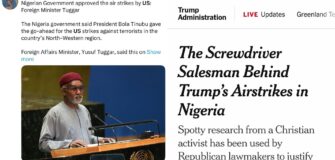


Trump Orders Christmas Night Airstrikes on ISIS Targets in Nigeria

Share

Donald Trump ordered US military airstrikes against ISIS-linked targets in Nigeria on Christmas night, marking a dramatic escalation in America’s counterterrorism response following deadly attacks on Christian communities in the country, according to US officials.
The strikes were launched after reports of mass killings of Christians in parts of Nigeria, attacks that US authorities attributed to ISIS-affiliated militants operating in the region. The operation, carried out under the cover of darkness, targeted locations believed to be used by the terrorist group for planning, logistics, and coordination.
Trump announced the strikes in blunt terms, describing the militants as “terrorist scum” and framing the operation as a direct response to what he characterized as religiously motivated violence. The language reflected a broader pattern of messaging that emphasizes swift retaliation and a hardline stance against extremist groups.
US defense officials said the airstrikes were intended to degrade ISIS operational capacity in Nigeria and disrupt future attacks. While specific details about casualties and damage assessments were not immediately released, officials indicated that the strikes were part of a broader effort to prevent further violence against civilians.
Nigeria’s long-running security crisis
Nigeria has faced years of insurgency and militant violence, particularly in the north and central regions, where armed groups have targeted villages, religious gatherings, and civilian infrastructure. While Boko Haram remains the most internationally recognized extremist group in the country, ISIS-linked factions have expanded their presence, exploiting local instability and weak security conditions.
The attacks on Christians during the Christmas period intensified international scrutiny and renewed calls for stronger intervention, particularly as religious violence continues to claim lives across multiple regions.
A signal beyond Nigeria
The decision to launch airstrikes on Christmas night carried symbolic weight, signaling both urgency and resolve. US officials said the timing underscored a message that attacks on civilians—especially during religious holidays—would draw immediate consequences.
The strikes also reinforce Washington’s strategic interest in West Africa, where militant groups have increasingly aligned with global terrorist networks. Analysts note that instability in Nigeria, Africa’s most populous country, has regional implications that extend beyond its borders.
What comes next
While the airstrikes represent a significant show of force, security experts caution that military action alone is unlikely to resolve Nigeria’s complex insurgency. Long-term stability, they argue, will depend on coordinated efforts involving regional governments, intelligence-sharing, and addressing the economic and social conditions that allow extremist groups to recruit and operate.
For now, the US operation places renewed global attention on Nigeria’s security crisis and signals that Washington is prepared to act decisively when American leaders view civilian attacks as crossing a red line.
As assessments continue, both Nigerian authorities and international partners are expected to monitor the aftermath closely, amid concerns about retaliation, civilian safety, and the broader trajectory of the fight against ISIS-linked groups in Africa.