

The Black Woman Whose Math Sent Astronauts to Space

Share
Did You Know a Black Woman’s Math Put Astronauts in Space, While She Was Forced to Use a “Colored” Bathroom?
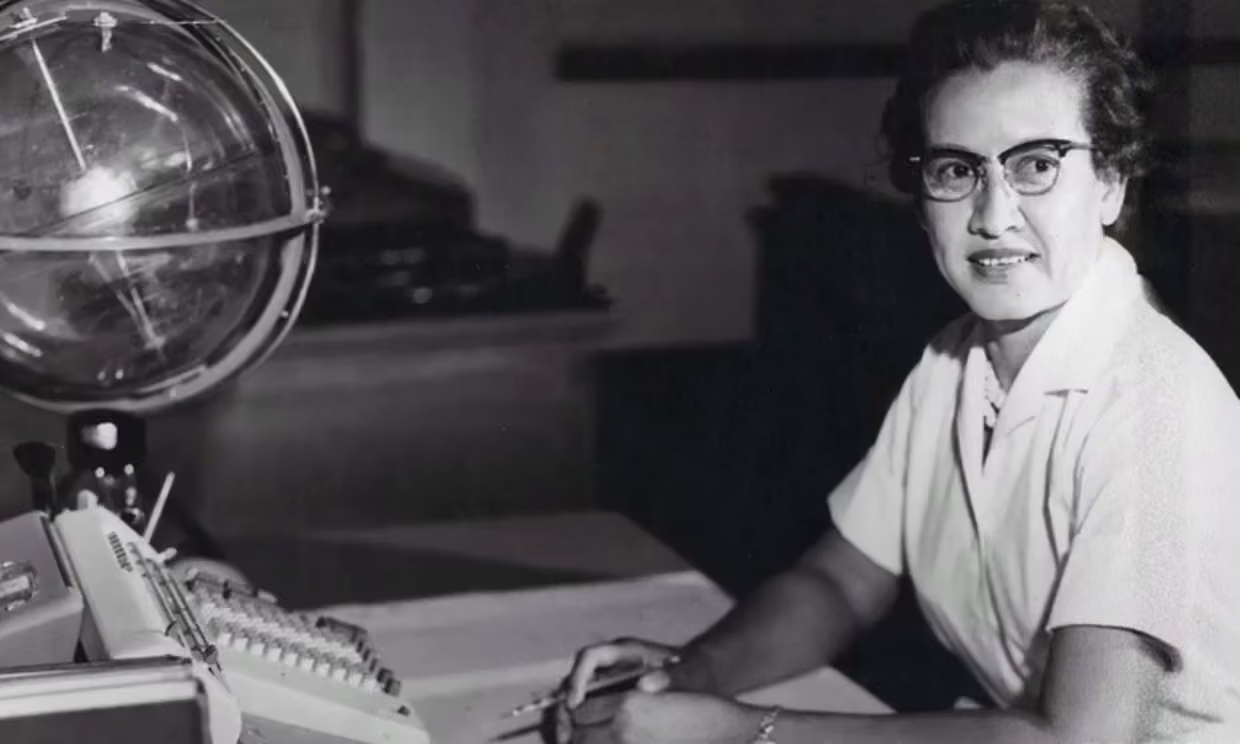
America’s space race is remembered through rockets, astronauts, and Cold War rivalry. Less often remembered are the people whose calculations made those launches survivable, and whose brilliance coexisted with everyday humiliation. One of them was Katherine Johnson, a Black woman whose mathematics helped send astronauts into orbit while segregation dictated where she could eat, work, and even use the restroom.
The contradiction is stark: Johnson helped map humanity’s path beyond Earth at a time when she was still navigating Jim Crow America on the ground.
The human computer behind the mission
Before digital computers dominated NASA, calculations were done by hand. At the Langley Research Center in Virginia, teams of mathematicians—many of them women, were known as “human computers.” Johnson stood out almost immediately.
Her work focused on analytic geometry and orbital mechanics, areas where precision was non-negotiable. A single error could mean a missed orbit, a failed reentry, or death.
When NASA prepared to send astronaut John Glenn into orbit in 1962, the mission carried unprecedented risk. Glenn famously requested that Johnson personally verify the computer-generated calculations before launch. If she said the numbers were right, he would fly.
She said they were right. He flew. He returned safely.
Solving equations under segregation
While Johnson’s work was mission-critical, her daily reality reflected the limits imposed on Black professionals in mid-20th-century America. She worked in segregated offices, attended segregated meetings, and was forced to walk long distances across campus to use a bathroom marked “Colored.”
These were not symbolic inconveniences. They were deliberate barriers, time-consuming, exhausting, and psychologically degrading, imposed on someone whose mind was solving problems at the frontier of human knowledge.
Johnson did not quietly accept them. She questioned policies, pushed to attend meetings reserved for men, and insisted on being included in briefings where her calculations were being discussed. Over time, her presence made exclusion harder to justify.
Math that shaped history
Johnson’s fingerprints are all over the early US space program. She calculated trajectories for the first American in space, verified orbital paths, and helped plan the reentry angles that allowed astronauts to survive return from orbit.
Later, her work contributed to Apollo missions and contingency plans for spacecraft failures. These were not academic exercises. They were life-and-death computations performed without the safety net of modern automation.
NASA’s success rested on trust in her numbers.
Why her story was nearly forgotten
For decades, Johnson’s contributions were known inside NASA but rarely celebrated publicly. The story of the space race favored astronauts and engineers, not the mathematicians behind the scenes, especially not Black women working in segregated environments.
It wasn’t until much later, through renewed historical interest and popular culture, that her role entered the mainstream narrative. By then, the gap between contribution and recognition had already spanned generations.
The real cost of the space race
Johnson’s story forces a more honest reckoning with American achievement. The space race was not powered solely by ambition and innovation, it was also powered by people who were denied basic dignity even as they expanded national prestige.
Her legacy challenges the idea that progress is clean or fair. It rarely is.
Katherine Johnson didn’t just help put astronauts in space. She proved that excellence can exist under injustice, and that history often advances on the backs of people it refuses to fully acknowledge.
Her equations carried astronauts beyond Earth. Her life reminds us how far America still had to go on the ground.