


Japan Issues Tsunami Warnings After Powerful Earthquakes Shake Coastal Regions

Share
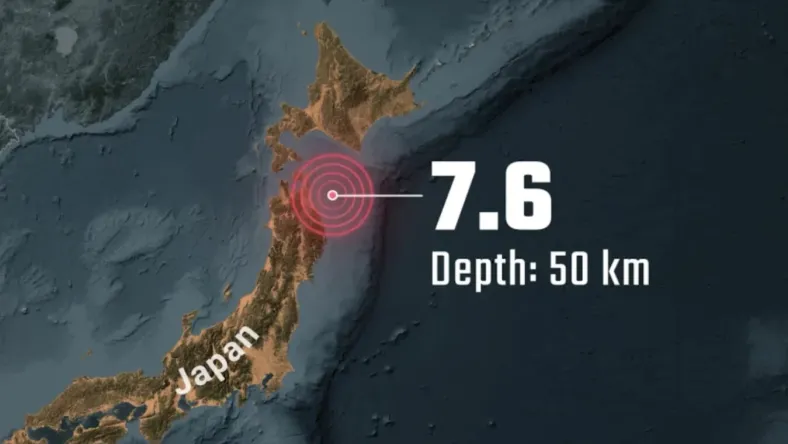
Japan is on high alert after a series of powerful earthquakes struck coastal regions, triggering immediate tsunami warnings and prompting thousands to evacuate to higher ground. The quakes, detected early Wednesday by the Japan Meteorological Agency, were strong enough to activate the nation’s emergency broadcast system, sending sirens and mobile alerts across several prefectures.
The shaking was felt across wide stretches of Japan’s coastline, with authorities urging residents near the shore to evacuate without delay. While early reports indicated that no major tsunami had yet made landfall, officials warned that dangerous waves could develop suddenly, especially as aftershocks continued to rattle the region throughout the morning.
Japan’s emergency procedures went into effect within seconds of the first tremor. Bullet trains slowed or halted automatically, coastal highways closed to non-essential traffic, and airports near the epicenter issued grounding advisories. Local governments opened evacuation centers as residents moved inland, carrying emergency packs and blankets as they gathered in gymnasiums and community halls.
The threat of large-scale waves immediately revived memories of the devastating 2011 earthquake and tsunami, which killed more than 15,000 people and remains one of the nation’s worst natural disasters. While Japan’s infrastructure and early warning systems have only strengthened since then, any tsunami alert is treated with the highest level of caution.
Seismologists said the initial earthquake occurred along the volatile Pacific Ring of Fire, one of the most active seismic zones in the world. Although Japan frequently experiences earthquakes, not all of them are strong enough to trigger tsunami alerts. Today’s activity, experts noted, met that threshold due to its depth, magnitude, and proximity to offshore fault lines.
International monitoring centers, including those in the United States and Southeast Asia, began tracking sea-level changes shortly after the quakes. The U.S. West Coast, Hawaii, and Pacific islands are not currently under threat, but agencies said they will continue to observe ocean patterns over the next several hours.
Japan’s central government urged calm while emphasizing that residents should not return to coastal areas until officials formally lift all warnings. Emergency crews are surveying local infrastructure, checking for damage to older buildings, ports, and seawalls. As of now, there are no confirmed reports of widespread destruction, though communication from smaller coastal towns remains limited.
The Black expat community in Japan, including students, teachers, military personnel, and business professionals, has been advised to follow official English-language updates shared by the U.S. Embassy in Tokyo and local municipal offices. Families in the United States have been encouraged to rely on verified news sources for accurate information as the situation continues to unfold.
Authorities are expected to release updated assessments throughout the day as seismic activity stabilizes. Tsunami warnings typically remain in place for several hours after the initial quake to ensure no delayed waves form following aftershocks.
For now, Japan remains in a state of precautionary readiness as officials evaluate the full impact of the earthquakes and determine whether the tsunami threat will intensify or gradually ease.